1. Welcome to the Recumbent Riders International forums.
    You are currently viewing the discussion boards as a guest which gives you limited access to view most discussions and other features. By joining our free community you will have access to post and reply to topics, communicate privately with other members, download/upload content and access other special features. Registration is fast, simple and absolutely free so please,
    Join the community today!
    If you have any problems with the registration process or your account login, please contact us.

TECHNOLOGY: The electric bike that could change delivery as we know it

Discussion in 'News' started by NewsBot, Dec 7, 2020.  |  Print Topic

  1. NewsBot

    NewsBot Fetching Recumbent News

    Name:
    I am a Robot
    image_asset_98893.jpg
    Bikes that carry heavy loads with the help of both electric and pedal power are emerging as a sprightly alternative to regular delivery trucks in big cities.
    TECHNOLOGY: The electric bike that could change delivery as we know it E&E News

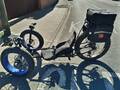
    Every Tuesday, a guy riding a weird kind of Tricycle coasts to a stop in the courtyard outside Kate's Ice Cream in Portland, Ore., to pick up a new shipment.

    He puts 30 cases of Kate's goods — vegan ice cream with flavors like waffle cone and marionberry cobbler — into freezer bags and places them alongside other freight in a steel box mounted behind his seat. Loaded with as much as 600 pounds of cargo, he turns onto Northeast Sandy Boulevard.

    Each pedal stroke is boosted by a silent electric motor hidden in the chassis. He takes the bike lane, despite commanding a 4-foot-wide commercial vehicle.


    After a mile-and-a-half ride, the trike arrives at the warehouse of B-line Urban Delivery, a logistics company located in the heart of the city and just blocks from the Willamette River. He unpacks the cargo at a warehouse that's smaller and more central than the kind of megaplex where package deliveries usually go.

    Every part of this scenario is different from how most last-mile deliveries are made today. It would be easy to dismiss B-line's service as just another Portland oddity. But similar projects are scaling up in European capitals like Paris and Berlin; just became legal in Chicago; and are being adopted in New York City, where Amazon.com Inc. has 200 such electric bikes making produce deliveries.

    "Not having a big diesel truck pickup is always helpful," said Katelyn Williams, the ice cream proprietor.

    That is the premise of the embryonic but fast-growing world of delivery e-cargo bikes, or e-trikes. It is a subset of the electric pedal-assist bicycles that are zooming in popularity during the pandemic. Advocates say small electric conveyances, roving short distances, can deliver goods more quickly in the dense parts of cities, while reducing the congestion, noise and pollution created by boxy trucks.

    The economics, however, haven't yet been proved on America's car-loving streets. The approach requires a thorough rethinking of how goods get into the city. And a new exotic species is sure to create conflict in areas already crowded with cars, cyclists and pedestrians.

    Squeezing in the last mile
    The e-cargo bike is a possible solution to one of the most vexing problems in the world of logistics. How do you get goods through the final link from warehouse to doorstep?

    The head-scratcher is that while the desire for delivery seems limitless, the amount of space on the curb is not.

    City residents are already familiar with box trucks and step vans parked (and double-parked) with their hazard lights flashing. For passersby, this means more congestion and air pollution; for shippers, it means higher delivery costs and slower delivery times. In October, researchers at the University of Washington found that delivery trucks spent 28% of their delivery time cruising, looking for a parking space.

    "There's a lot more need for access to the curb than we have actual curb," observed Mary Catherine Snyder, a strategic parking adviser for the city of Seattle, which trialed an e-trike with UPS Inc. last year.

    The COVID-19 pandemic has only intensified the scrum. Services like UPS and Amazon have seen a crest of business during lockdowns. Offices may be empty, but downtown curbs are clogged anew by delivery people conveying meals from restaurants to homes through services like Grubhub Inc. and DoorDash Inc.

    Experimentation is afoot. Some logistics firms are testing customers' tolerance for avoiding the doorstep and instead leaving parcels in lockers or, in the case of Amazon, in a vehicle's trunk. Even drones are a possibility, though they are likely too expensive except for transporting lightweight, high-value items, like medicines.

    E-cargo bikes tackle a different section of the last mile: the span from warehouse to curb.

    Advocates say a small, agile tricycle is faster and produces less climate-warming emissions than a truck. It maneuvers better in traffic and can park in smaller spaces, or even on the sidewalk.

    According to a study of an e-cargo bike deployment last year at the University of Toronto, replacing a regular delivery truck with an electric cargo bike reduced carbon emissions by 1.9 metric tons per year — though multiple e-cargo bikes are often needed to carry as much as a regular delivery truck.

    The denser the neighborhood, the lower the cost of delivery by bike becomes, Franklin Jones, the CEO and founder of B-line, said during a recent webinar.

    "When riding elevators, it doesn't matter what you're driving," he said.

    One crucial change is required for the e-cargo bikes to thrive: small, local warehouses. Most logistics companies pin their cavernous warehouses on the periphery of cities. But because the bikes' range is so short, they need a facility nearer by. They're called microhubs.

    Such petite outposts, dubbed logistics hotels, are already in use in Paris. On these shores, a startup called Reef Technology won $700 million in funding last month for its hubs based in urban parking lots, for purposes including last-mile delivery.

    Amazon is also in the process of building 1,000 small delivery hubs across the United States, with more to come, according to Bloomberg.

    To work with cargo bikes, such microhubs would need to be sprinkled within radiuses of 2 to 6 miles, depending on urban density, said Sam Starr, an independent sustainable-freight consultant in Canada.

    In the United States, the results for e-cargo delivery are so far inconclusive. A UPS trial of e-cargo trikes in Seattle last year found the bike delivered far fewer packages in an hour than a regular truck in a busy Seattle neighborhood.

    The study judged that the experiment, which only lasted a month, may simply have been too short for bike deliveries to hit a groove. But it also pointed out that the bikes' advantage — their diminutive size — is also a weakness.

    "Cargo e-bikes may not be as efficient as trucks at performing deliveries and pick-ups," said the study. "Their limited cargo capacity means that they can perform fewer deliveries per tour, and they have to re-load cargo more often."

    A slow grind to acceptance
    In New York City, an entrepreneur named Gregg Zuman, founder of Revolution Rickshaws, has been trying for the last 15 years to bring e-cargo bikes to the masses. He's still trying.

    What are the barriers? "There's a lot," he said.

    Zuman's first idea, in 2005, was to create a fleet of electric pedicabs. That ran afoul of the city's taxi lobby. In 2007, the state Department of Motor Vehicles determined that commercial bikes could only be human-powered, meaning no nudge from an electric motor. Revolution Rickshaws was sidelined for more than a decade.

    Last year came an opportunity to undo the logjam. New Yorkers, like city residents everywhere, became enamored of electric street scooters and electric-assist shared bicycles.

    In December, the city approved a trial of e-cargo bikes in Manhattan by big logistics companies including UPS, Amazon and DHL. Meanwhile, mobility providers like Bird, Uber and Lime, eyeing the country's largest market, persuaded the state Legislature to legalize electric scooters and bikes. In January, Gov. Andrew Cuomo (D) dropped his objections and made the bill law.

    But a provision limited the width of the vehicles to 36 inches.

    "That took our knees out," said Zuman, pointing out that virtually every e-cargo bike on the market is at least 48 inches wide.

    Federal law is silent on the topic of electric cargo bikes. In cities and states, rules vary widely, if they exist at all.

    Chicago in October became one of the first cities to codify its rules. The city's aldermen approved regulations that allow e-cargo vehicles to travel in bike lanes. They are limited to top speeds of 15 mph and a width to 4 feet. Drivers need a bike-messenger permit, and bikes have to park in regular parking spaces.

    Amazon goes big
    One company in New York City does have a 36-inch-wide bike and has ambitious plans for it: Amazon.

    Over the last 18 months ...

    Continue reading...
     

Share This Page